

I learned to stop worrying and eat an Ant's Nest for Breakfast
Where do I begin?
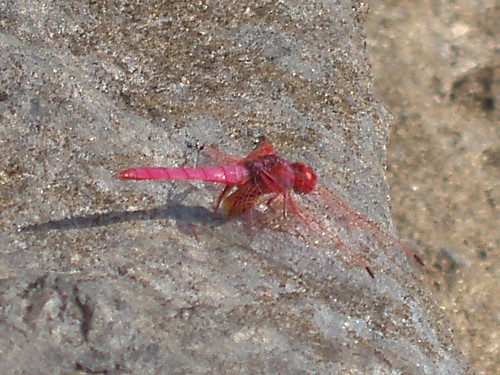
We had chosen the 'nature trail', and although we did not come any where near seeing Tigers, Gibbons or the Siamese Crocodile we did see recent evidence of Deer, Wild Boar and wild (?Civet) cats nearby. The most astounding array of luminous butterflies were there in every hue of the rainbow; dragonflies were fluorescing in [pink, blue and green; mushrooms and fungus adopted every natural and seemingly artificial hue from deep velvet purple, vermilion orange and GI green. Orchids great and small hung on every tree and in every crevice along the route.
It seemed that we were carrying suspiciously little food for 4 strapping lads and I as we set off from our base. A large plastic bag of sticky rice, small packet WaiWai noodles, onions, chilli and garlic, half a cabbage, small bottles of squid brand fish sauce and Maggi (soy sauce) seasoning, a nob of luncheon meat style pork sausage, a flattened grilled chook (more head and scrawny feet than meet) and some sheets of what turned out to be delicious "heaven's meat" or air dried beef (or other red meat?).
This was ample as it turned out. With only a couple of tin dishes and cups of Bob and I (the falang), the only other utensil was a smallish saucepan. This, along with the multi-purpose machete and a cigarette lighter was sufficient not only to feed us, but to provide us with a feast to write home about (what do you think that I'm doing?).
 We left Vientiane with our not-so-good-English speaking guide Sai for one of the few National Protected Area's (NPA) about 120km north of the Capital. On the way we picked up our two local guides form a village on the fringe of the NPA, and then after passing through the checkpoint and paying our entrance fee, made our way to Tad Leuk, a popular waterfall for locals onto he weekend. At the shelter which sold drinks and food, we had what could only be described as a feast; sticky rice to roll into balls and dip in sauces and spice; a hot, whole grilled river fish with it's skin deliciously crispy with salt; papaya salad and baguette sandwiches for our falang tastes. They were good, but unnecessary with the excellent local food.
At around 12:30pm we were on our way. The bush was similar at this stage to much of that found around water courses at home. Within 10 minutes however, rumbling thunder made me look for the local subway station, and the bush turned to tropical jungle and we climbed away from the water course and into bamboo forest.
 Boy, do I have a new respect for bamboo! During the trek on the first afternoon, we spent much of the time crawling on our hands and knees, slunk low to the ground so that our packs wouldn't catch, on the dense, canopy of dry bamboo poles which had formed tunnels overhead, and offered sharp splinter to catch eyes, ears and arms at every step. Occasional breaks into fresh green bamboo permitted us to walk hunched, or at times, even upright, however the rain had started after we had been on the trail for 20 minutes and the almost impenetrable thicket meant that we were largely dry. Even with this difficult movement, the local guide at the front (LG1) was using his machete to hack our way through almost constantly. The second Local Guide (LG2). Came up the rear carrying a tent, a couple of sleeping mats and bags in his hands. Both the local guys were wearing rubber thongs, and managed to step through the thicket of wines and bamboo without consequence.
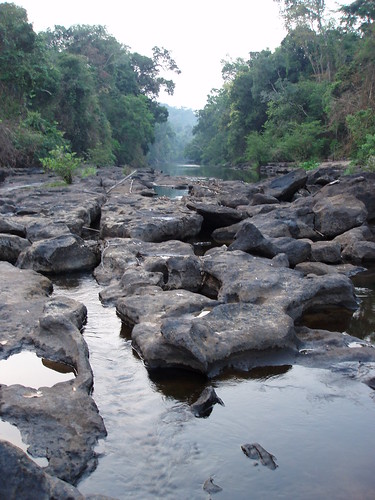
 At our camp site on the flat smooth rocks of the river we set up camp for the night, bathed in the clear running runner and collected dinner. Already along the trail, LG2, now known to be called Choi (left), had excitedly collected some leaves which were explained to us were sweet when cooked. Wild ginger had been dug from the ground when the tell tale leaves were seen, and we ate some wild mangos, no bigger than a plum, that although slightly sour, were eaten with the skin intact and left a strong mango aftertaste. Bamboo flowers were hulled to reveal a kernel inside which substituted for rice and had a good, slightly nutty flavour. So much was here, that living off the land was not just feasible, but an important way of like for many of the Sao Lao, ordinary people, who lived in the Ban villages and had a largely subsidence and barter lifestyle.
 As we sat on the river bank, marvelling at the variety of insects around, the local guides quickly and effortlessly collected hardwood and bamboo for a fire, set traps for fish for breakfast and cut down the magic bamboo for it's myriad of uses. Bamboo supplemented our tent poles, was used as fire wood, and boiled water. Into he photo above, Choi is stuffing sticky rice that was first soaked in the river in a plastic bag until it swelled and absorbed the water, into bamboo poles, which are then stuffed with bamboo leaves at the top, and placed on the fire to steam. When the steam comes out of the end like a 'peace pipe' it is ready, and delicious! A deft hack splits the bamboo in two lengthwise and perfect round cylinders of the precious stuff if perfectly cooked and served.
With accompanying sounds of birds, insects, frogs and running water, Bob sampled the local Lau Lao, strong local moonshine made from rice, presented to him in a quickly and beautifully constructed cap, the size of a demi-tasse, constructed of green bamboo which maintained the liquid and provided thermal qualities.
Amazingly Sai brought about a dozen eggs, held only in a plastic bag inside his flimsy, broken backpack. Of these, only one was broken. We shared a meal of chicken soup, with a few fish caught early BBQ'd on split green bamboo; sticky rice with the ubiquitous Maggi seasoning, slices of the luncheon meat style sausage, boiled eggs, and green leaves. It was wonderful, and small orange votive candles were lit as the light faded, providing one of the most spectacular dinner settings imaginable.
We didn't realise how this could, and would improve in the days to come. We slept well to the forest sounds, waking at first light when the guys went to check their traps.


I've just printed this off to give to Rad when I next see him.
He'll be just as amazed at your adventures, as I am.
And awesome writing about it almost as soon as it happens.
Glad you slept well in the jungle FD. Hold on, t-tigers ?